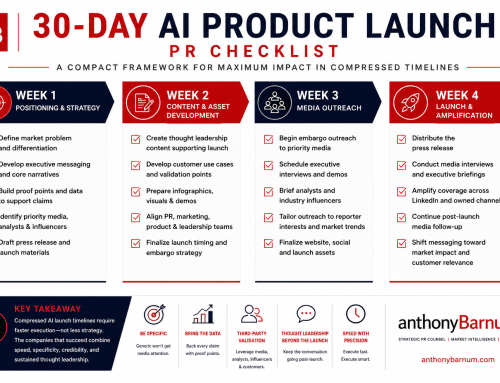
In 2026, we are well past the days when AI launches automatically generated awareness and differentiation. Growth-stage technology companies backed by investors have to do more than announce their products. They have to build category narratives with meaning, substance, and measurable outcomes that educate their markets.
There is a good reason to take a much deeper PR approach. While AI launches continue to dominate headlines, the bigger challenge begins after launch. MIT research found that 95% of enterprise generative AI pilots fail to deliver measurable ROI. For marketers, the real challenge is not simply creating visibility around an AI platform. It is educating the market on how the platform generates value, creates meaningful efficiencies, and can be successfully deployed.
AI is transforming every corner of business and industry, but the challenges in delivering ROI are real. Top technology and business reporters have been increasingly open about AI fatigue. It is not that journalists are tired of AI itself. What they want is differentiation, analysis, and insight. The proof has to be in the pudding, as they say.
As companies navigate complex tech stacks, high costs, competing priorities, and pressure to demonstrate returns, marketers must build the case for AI’s value. PR is one of the most powerful formats to do so.
To go from launch to category leadership, companies need to focus on sustained market education.
1. Lead with Customer Outcomes, Not AI Features
Models, automation, and technical capabilities are important, but buyers care about business impact. Market education should consistently demonstrate how the technology improves workflows, reduces costs, increases productivity, mitigates risk, or drives revenue.
Customer examples, pilot results, benchmarks, and measurable outcomes help move the conversation from AI hype to business value. The key is to make the story tangible, measurable, and, where possible, supported by customers, partners, or outside experts.
2. Create a Sustained Thought Leadership Program
The launch should be the starting point for a long-term thought leadership program. Subject matter expert commentary, contributed content, original research, customer insights, and trend analysis all help position a company as an authority.
The objective is not simply to generate coverage. It is to help shape how customers, analysts, investors, and media understand the market’s evolution and the company’s role within it.
Exceptional thought leadership builds over time. These strategies are developed brick by brick, and consistent, innovative thinking is essential for scaling meaningful visibility and credibility.
3. Build Third-Party Credibility Across Multiple Channels
Market education is most effective when validation comes from sources outside the company. Media coverage, analyst engagement, customer advocates, industry influencers, ecosystem partners, and independent research all reinforce credibility.
Buyers increasingly look for consensus before making technology decisions. In high-stakes AI investments, third-party validation is a critical component of both awareness and adoption.
In the earlier days of AI, there was far more opportunity to pontificate about future potential. anthonyBarnum was launching global, headline-grabbing AI platforms as early as 2018, when media, investors, and companies were still wowed by what AI could become.
But today’s AI market is different. The winners are rarely the companies with the loudest launch. They are the companies that invest in sustained market education and continuously demonstrate value, expertise, and relevance long after the announcement.
As AI launches become more crowded, the need for credible, specific, and sustained PR only grows — reach out if you want to talk through how to make your next launch count.