As AI increasingly becomes the first stop for B2B research, many technology marketing executives are seeing a shift in how buyers discover companies. Traditional organic search traffic is declining as users turn to AI search experiences for direct answers instead of clicking through to websites.
For organizations that rely primarily on SEO and owned content, this shift often means fewer website visits. AI systems frequently summarize information without directing users to the original source. At the same time, companies with strong earned media, analyst coverage, executive thought leadership, customer success stories, and authoritative third-party content are more likely to be surfaced in AI-generated responses.
Recent research reinforces this trend. Muck Rack’s analysis of more than one million AI citations found that 82–85% of citations originated from earned media, with more than 95% coming from non-paid sources. Similarly, a Stacker/Scrunch study found that distributing content through trusted third-party publishers significantly increased AI visibility.
The result is a fundamental shift in marketing strategy. While SEO optimizes webpages for search engines, public relations builds the reputation, authority, and context that AI systems use to evaluate and recommend companies. PR is becoming an essential component of AI discoverability and category leadership.
Organizations that consistently invest in public relations create the trusted signals AI models rely on to understand a company’s expertise and relevance. These signals include:
- Coverage in respected business and trade publications
- Executive interviews and contributed articles
- Analyst recognition
- Customer success stories
- Industry conference participation
- Consistent messaging across trusted third-party sources
As more buyers rely on AI to evaluate technology vendors, the quality and breadth of these third-party signals carry greater weight. PR provides independent validation that helps AI systems assess credibility and determine which companies should be included in recommendations.
Beyond visibility, PR also shapes how AI understands a company. Consistent messaging helps establish category leadership, reinforces expertise, and associates a company with the markets and challenges it is best positioned to solve. Whether the category is agentic AI, agentic customer experience, autonomous operations, or AI security, sustained media visibility helps define that association.
The role of PR has evolved beyond generating awareness. In the era of AI search, it creates the authority, trust, and context that influence how companies are discovered, understood, and recommended. SEO helps a website rank. PR helps AI understand why a company deserves to be recommended in the first place.
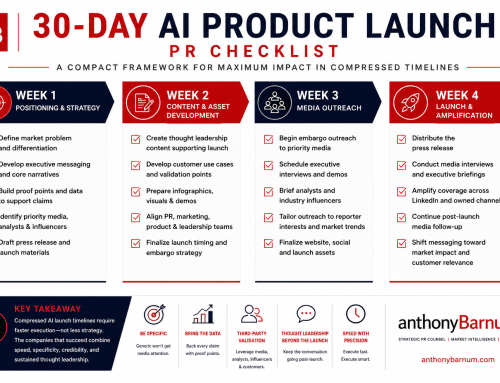
As AI launches become less likely to stand out on their own, the need for sustained market education, measurable proof, and third-party credibility only grows — reach out if you want to talk through how to turn your next AI launch into lasting category leadership.