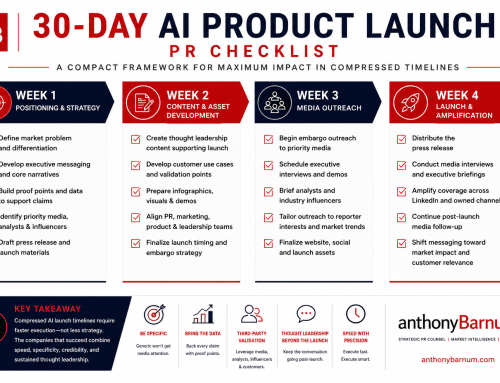
 PR is pivotal to a successful AI launch. Media placements build third-party credibility, fuel GEO search visibility, and communicate key messages and differentiation to decision-making and market-shaping audiences.
Momentum matters. Yet launch timelines are compressing as companies race to establish leadership positions and claim first-mover advantage. Not every marketing and PR launch will benefit from a traditional 90-day runway. Companies are working with 45-, 30-, or even shorter timelines.
Given those realities, what should an effective AI product launch look like under compressed conditions?
Here’s what I recommend for shorter-timeline launches:
1. Start Immediately
With launch timelines shrinking, PR teams simply do not have time to spare. Historically, product launches were often calibrated around 90-day planning cycles. Today’s AI launches—whether new features or full platforms—are operating in a race against time.
The fundamentals of effective PR have not changed. What has changed is the speed and precision required to execute them.
PR teams need to rapidly:
- Identify priority media with precision
- Develop executive positioning and market narratives
- Build an execution strategy
- Create launch assets and supporting materials
The same strategies and tactics still work—but they must be executed faster, more deliberately, and with sharper focus.
2. Build a Thought Leadership Platform Around the Launch
Many marketing executives focus heavily on the press release. But in AI launches, the broader market narrative surrounding the announcement is often equally important.
Thought leadership should position the solution within the larger market conversation and ideally begin before the release, continue alongside it, and extend well beyond launch day.
Effective market positioning typically incorporates:
- Internal performance or efficiency data
- Customer use cases and pilot results
- Third-party research and findings
- Market trends that reinforce the value proposition
The goal is not simply to announce a product, but to frame why the advancement matters and why the market should care now.
3. Generic Messaging Will Not Work
In my blog Deep Insights and Long-Form Content Wins, I discussed the importance of specificity in AI-related PR. That principle becomes even more critical during a launch.
This applies across:
- The press release
- Executive commentary
- Supporting market narratives
- Launch content and campaign assets
The market is increasingly skeptical of vague AI claims. Buyers, analysts, and media expect substance. Positioning and narratives need to be specific, defensible, and supported by data.
Generic claims about “innovation” or “transformation” are no longer enough.
Companies should be prepared to demonstrate:
- Workflow improvements
- Operational efficiency gains
- Customer impact
- Quantifiable business outcomes
- Real-world use cases
Detailed launch content, executive commentary, and earned media placements now contribute directly to GEO discoverability and AI search visibility. Substance matters more than ever.
4. It’s Not Just About Sending a Release
Strong launch execution goes well beyond distributing a press release.
To maximize outcomes, the release should typically be embargoed and shared in advance with a targeted group of priority media aligned to the company’s key audiences. Even in compressed launches, this process usually requires one to two weeks of focused outreach and coordination.
It’s not simply about providing early access to the release. The outreach needs to wrap the announcement within a broader industry context and credibility-building themes to create a compelling argument for why the advancement matters.
That is what increases the probability of meaningful coverage.
5. Third-Party Validation Extends Beyond Traditional Media
Media remain critical credibility-builders, but they are no longer the only market validators during AI launches.
Analysts, technical influencers, LinkedIn creators, customers, ecosystem partners, and industry experts can all play an important role in amplifying visibility and reinforcing credibility— especially during compressed launch cycles.
AI buyers evaluate consensus, not just headlines. Companies should think broadly about the voices and communities that influence their markets.
6. The Real Work Continues After Launch
The release itself has a long tail.
For launches operating on compressed timelines—two to four weeks, for example—the post-launch follow-up becomes even more important. PR teams need to quickly transition from simply announcing the product to demonstrating why the advancement represents a breakthrough and why it matters to customers, industries, and markets.
The conversation needs to evolve toward:
- Customer pain points
- Market trends
- Operational impact
- Competitive differentiation
- Industry relevance
Pre-launch outreach may last one to two weeks. The post-launch thought leadership cycle often continues for another month or more.
7. Supporting Assets Increase Impact
Infographics, product visuals, demo videos, and supporting graphics should be developed collaboratively between PR and marketing teams.
Media need more than claims; they need context and evidence to evaluate the innovation and its market relevance. Even simple visual assets that clearly demonstrate a pain point, workflow improvement, or platform capability can add meaningful dimension to a launch narrative.
Strong visuals also improve engagement across earned, owned, and social channels.
8. Want to Break Through? Get In Front of Media
The AI media landscape is becoming more and more crowded. Reporters are dealing with a constant barrage of announcements, platforms, and breakthrough claims.
Companies that want outsized visibility need to take calculated risks and invest in relationship-building.
Those can include:
- In-person executive briefings with top-tier media
- NYC media tours for fintech and financial services platform companies
- Virtual demo sessions with California tech media
- In-person meetings with industrial and energy media in Houston
- One-to-one reporter meetings at major industry conferences
Relationships still matter. Accessibility matters. Being an informed, credible, in-person resource can significantly improve long-term coverage opportunities.
In AI markets, speed matters, but credibility shouldn’t be sacrificed. The companies that win compressed launches are the ones that combine urgency with substance, precision, and sustained market education and connection.
As AI launch timelines get shorter, the need for credible, specific, and sustained PR only grows — reach out if you want to talk through how to make your next launch count.