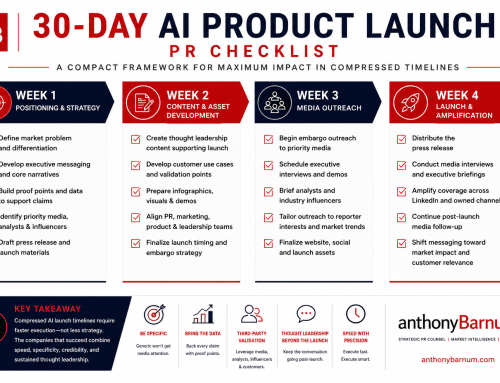
AI has to prove out its merit from the hype and buzz of 2025. Agentic AI and other advancing technologies must deliver tangible ROI on their transformational capabilities. Empty press releases and surface-level thought leadership won’t convince B2B tech buyers, nor will they convince increasingly savvy tech reporters and editors. The days of visioning concepts for AI are out the window – as business buyers decipher how they can practically use AI to forward their objectives.
For years, I’ve been a proponent of data narratives to drive key aspects of PR, but today, amid so much soft AI content, it’s crucial. PR strategies need to respond by leading with outcomes, not tech narratives or storylines.
Here’s what’s going to drive the best results in PR –
Outcomes, not tech whiz – Buyers assume everyone has an AI-something or another. Instead of soft talk about “optimizing workflows,” think about it in more specific, measurable business impacts. For example, “We reduced procurement cycle time by 35% using autonomous agents across X and Y platforms.” Quantification is more credible.
It’s already the agentic economy – Everything is AI, so it’s not a standalone. The positioning for your platform should focus on replacement, augmentation, or orchestration. The foundation of the PR narratives should focus on how the technology is working to improve efficiency, aligning with how analysts and media are now framing the market. For example, “X technology is the control layer for autonomous operations” OR “X enables AI agents to execute across Y enterprise systems.”
It’s not about the product – Product stories aren’t in the spotlight anymore; the ecosystem is what matters. How a platform creates greater productivity and systemic transformation is important to highlight in PR narratives. The integrations and where the solution sits in the stack are more important than standalone features.
Make security and governance central – New and advancing technologies come with their own risks. As AI evolves, so do vulnerabilities. Auditability, compliance, and certifications that support security and governance are messages to get out in PR. Marketers should explain to their audiences how their solutions are designed to minimize risks at every available opportunity – a certification release, data narratives, and analysis.
Elevate customers as the main characters whenever feasible – CIOs, CROs, and COOs that can support narratives around a platform’s value – whether its total transformation, enhanced productivity, quantifiable efficiency gains – are extremely important to building credibility. Marketers should work with their leadership to go after friendly customers who may have a stake in growing their own visibility. It’s hard to do, but it needs to get off the backburner as a nice-to-have and become a strategic priority to pursue and secure.
Overall, be brutally specific – The fastest way to lose attention now is abstraction. PR initiatives need to capture narratives centering on specific workflows, named systems, and concrete metrics. Customers and media are done with vagueness. They understand there is a great opportunity in AI, and now they want to know how it fits together for them.
The PR that worked just a couple of years ago won’t resonate the same way. Content is cheap and easy to produce now – data, customers, outcomes, and risk mitigation are not. It may be challenging, but the value of going deeper will pay off in a strategic and intensive PR campaign.
Also, marketers, you have more than you think. One of the most common things we see in companies when we enter the picture is data, customers, and governance/security information that can be repositioned, dusted off, and shaped into meaningful PR assets. You likely have gems that a PR team can rework to drive PR visibility.
2026 is the year PR moves past AI hype and proves value through outcomes, evidence, and specificity — reach out if you want to talk through how.